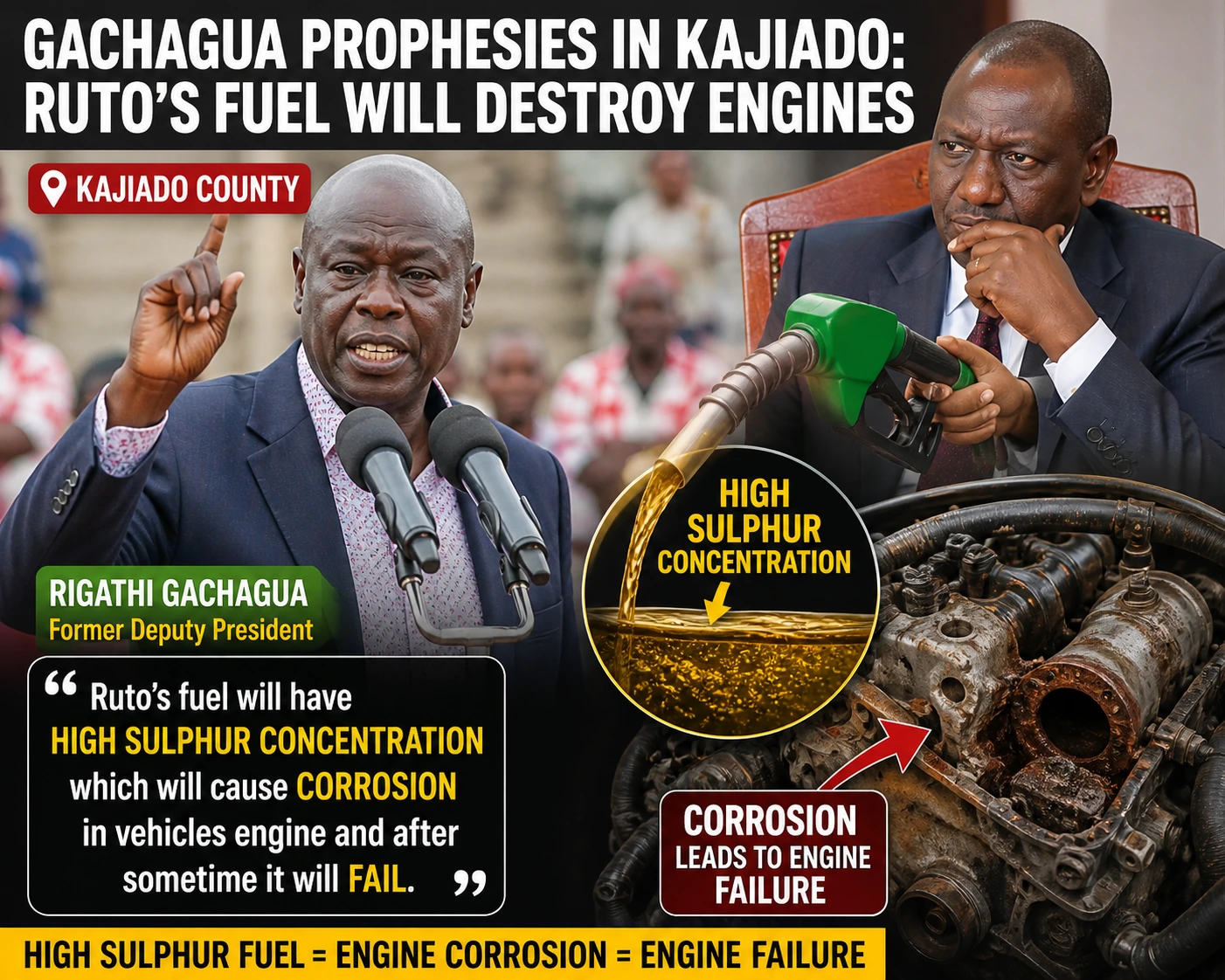
In a dramatic address in Kajiado, former Deputy President Rigathi Gachagua has issued a stark warning: thousands of Kenyan motorists could face catastrophic engine failure following the government’s decision to allow the importation of high-sulphur fuel.
Speaking just days after the government announced a temporary relaxation of fuel quality standards, Gachagua accused President William Ruto’s administration of knowingly permitting “dangerous” and “substandard” fuel into the country—a move he claims will trigger a “national crisis” of vehicle breakdowns and economic disruption.
But is this a genuine mechanical time bomb, or political prophecy from a leader locked in a public feud with his successor? Here is what the science says and what drivers in Kajiado—and across Kenya—need to know.
Gachagua’s warning on May 1, 2026, painted a grim picture of the nation’s roads. He alleged that the excessive sulphur content in the current fuel supply would have “devastating mechanical effects,” ultimately choking the economy by grounding the transport sector.
The policy in question, however, was presented by the government as a necessary evil. On April 30, the Ministry of Investments, Trade, and Industry (CS Lee Kinyanjui) authorized a six-month waiver.
Citing severe global supply disruptions due to the conflict in the Middle East—specifically regarding the Strait of Hormuz—the government raised the permissible sulphur content in petrol and diesel from the East African standard of 10 milligrams per kilogram to 50mg/kg.
Officials argue that this prevents a total fuel drought. Gachagua argues it is a slow poison for the nation’s engines.
But the question is Why Sulphur is the Enemy of the Engine
To understand Gachagua’s warning, one must look at the chemistry under a car bonnet. While the difference between 10ppm and 50ppm sounds minuscule, automotive experts confirm that the change is significant.
When high-sulphur fuel burns, it produces sulphur dioxide. Inside an engine, this mixes with water vapor to create sulphuric acid. Mechanics warn that this acid is highly corrosive.
"It eats away at critical engine components such as piston rings, bearings, and valve systems,It results in excessive corrosion of the engine parts".Says Gachagua
When this acid contaminates the engine oil, it breaks down the additives designed to protect the engine, leading to rapid wear and tear.
The most vulnerable victims of this prophecy are owners of modern vehicles. The majority of cars on Kenyan roads are imported second-hand from Japan and Europe, mostly Euro 4 and Euro 5 standards.
These engines are specifically calibrated for "Ultra-Low Sulphur Diesel" (10ppm). Feeding them 50ppm fuel is akin to giving a human contaminated water. It leads to clogged fuel injectors, damaged catalytic converters, and—in diesel vehicles—blocked Diesel Particulate Filters (DPF).
Now, he returns to the same ground to warn that the President is breaking their cars.
While the "prophecy" of engine failure serves a political purpose, the science supports Gachagua's underlying point. The government’s decision to revert to 50ppm—a standard phased out in the EU years ago—is a real stress test for Kenya’s vehicle fleet.
Speaking just days after the government announced a temporary relaxation of fuel quality standards, Gachagua accused President William Ruto’s administration of knowingly permitting “dangerous” and “substandard” fuel into the country—a move he claims will trigger a “national crisis” of vehicle breakdowns and economic disruption.
But is this a genuine mechanical time bomb, or political prophecy from a leader locked in a public feud with his successor? Here is what the science says and what drivers in Kajiado—and across Kenya—need to know.
Gachagua’s warning on May 1, 2026, painted a grim picture of the nation’s roads. He alleged that the excessive sulphur content in the current fuel supply would have “devastating mechanical effects,” ultimately choking the economy by grounding the transport sector.
The policy in question, however, was presented by the government as a necessary evil. On April 30, the Ministry of Investments, Trade, and Industry (CS Lee Kinyanjui) authorized a six-month waiver.
Citing severe global supply disruptions due to the conflict in the Middle East—specifically regarding the Strait of Hormuz—the government raised the permissible sulphur content in petrol and diesel from the East African standard of 10 milligrams per kilogram to 50mg/kg.
Officials argue that this prevents a total fuel drought. Gachagua argues it is a slow poison for the nation’s engines.
But the question is Why Sulphur is the Enemy of the Engine
To understand Gachagua’s warning, one must look at the chemistry under a car bonnet. While the difference between 10ppm and 50ppm sounds minuscule, automotive experts confirm that the change is significant.
When high-sulphur fuel burns, it produces sulphur dioxide. Inside an engine, this mixes with water vapor to create sulphuric acid. Mechanics warn that this acid is highly corrosive.
"It eats away at critical engine components such as piston rings, bearings, and valve systems,It results in excessive corrosion of the engine parts".Says Gachagua
When this acid contaminates the engine oil, it breaks down the additives designed to protect the engine, leading to rapid wear and tear.
The most vulnerable victims of this prophecy are owners of modern vehicles. The majority of cars on Kenyan roads are imported second-hand from Japan and Europe, mostly Euro 4 and Euro 5 standards.
These engines are specifically calibrated for "Ultra-Low Sulphur Diesel" (10ppm). Feeding them 50ppm fuel is akin to giving a human contaminated water. It leads to clogged fuel injectors, damaged catalytic converters, and—in diesel vehicles—blocked Diesel Particulate Filters (DPF).
Now, he returns to the same ground to warn that the President is breaking their cars.
While the "prophecy" of engine failure serves a political purpose, the science supports Gachagua's underlying point. The government’s decision to revert to 50ppm—a standard phased out in the EU years ago—is a real stress test for Kenya’s vehicle fleet.